

HANGING OUT
Unoptimised socialising: a breath of fresh air

You know that rush of relief when plans get cancelled?
If internet memes are anything to go by, it’s a very common feeling:1

Gaining a few empty hours is a blessing when you’re busy, tired, or overstimulated.
But the relief can be coupled with sadness: Why don’t I have more energy for my friends and family? Or for new experiences?
And the comforting resonance of cancelled-plan-smugness-memes is also bittersweet: Why is this such a thing? What does it say about modern society that we’d rather not see our friends than see them?
In Sheila Liming’s (2023) book, Hanging Out: The Radical Power of Killing Time, I found a nuanced and sound explanation for the phenomenon. And a solution.
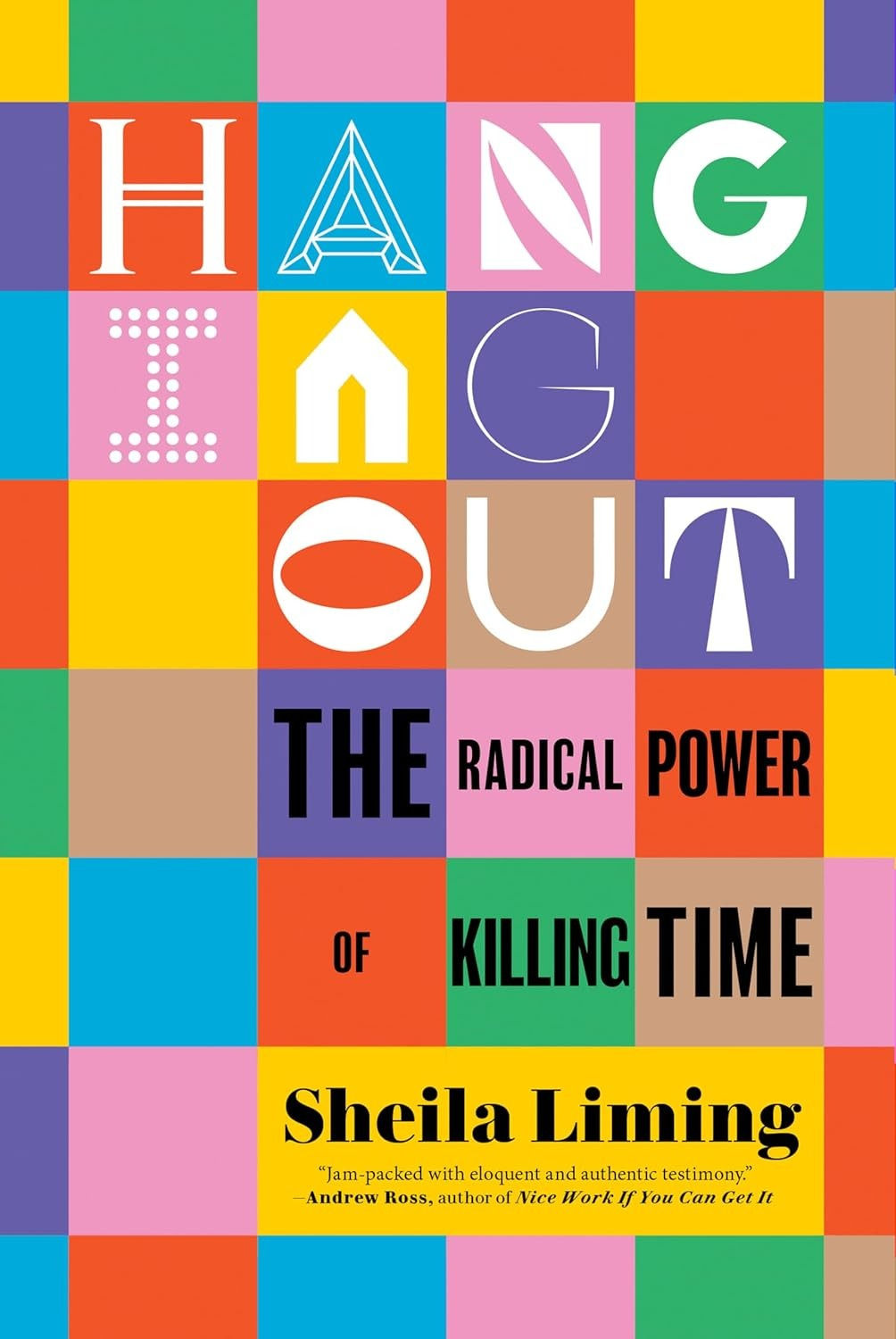
The central thesis of the book:
We need to remove our modern productivity mindset from our social lives and instead approach them with generosity, abundance, and inefficiency.
To do so, we need both time and space.
TIME
To hang out well, we need to be generous with the time we devote to hanging out. We need to:
Prioritise it: We make time for things we find important. For Liming, hanging out “is about blocking out time and dedicating it to the work of interacting with other people, whoever they may be.” (Liming, 2023, p.x).
Give it space: You can’t have quality without quantity. A good hang out isn’t likely to fit perfectly in an allocated slot in your diary. It needs time to unspool and develop. This means making social plans open-ended, rather than squeezing them between things (and then feeling relieved when they’re cancelled). Being the subject of someone else’s optimisation never feels good.
Repeat it: This is one of the most compelling arguments of the book: if you know that a ‘hang out’ will happen again, you take the pressure off of it. You don’t need it to be perfect, or even good, each time. You can show up even if you’re not feeling 100%, trusting that your friend(s) won’t write you off because of it. They’ll see you again next time because next time is assumed rather than conditional.
SPACE
Hanging out can happen anywhere, but certain places make it more possible. Last week I wrote about Viennese Coffee Houses and London Pubs. I described both as ‘public living rooms’, but they could also be described as sociologist Ray Oldenburg’s ‘third places’, which Liming cites as optimal for hanging out.
Oldenburg’s criteria for ‘third places’:
“Open and inviting. - You don’t need an invitation or appointment, and you can come and go as you please.
Comfortable and informal. - You feel that you belong there.
Convenient. - It’s close enough to visit often, ideally right in your own neighborhood.
Unpretentious. - Everyone is on the same level, there’s nothing fancy or fragile, and it’s not expensive.
There are regulars. - And often there’s a host who greets people as they arrive.
Conversation is the main activity. - Discussion, debate, and gossip are part of the mix.
Laughter is frequent. - The mood is light-hearted and playful. Joking and witty banter are encouraged.”2
In London, we’re fortunate to have lots of warm, spacious buildings that are open to the public and do not require the purchase of anything. Some of my favourites are clustered together along the River Thames’ South Bank: The National Theatre, The BFI, The Southbank Centre.


Inspired by Liming’s book, I experimented with a new event: HANGING OUT AT THE SOUTHBANK. A repeatable, open ended chunk of time in a free, public space.
I used Liming’s definition for ‘hanging out’ in the event description on Meetup:
“daring to do nothing much, and even more than that, about daring to do it in the company of others.” (Liming, 2023, p. x)
This seemed to strike a chord with over 100 people signing up for the pilot event.
Before that first event, I was curious to find out how people would experience such a vague, unstructured event. Would it be enough to just meet up and hang out?
I made the following hypotheses:
HYPOTHESIS 1: The first event might feel a little underwhelming compared to my other, more structured events (e.g. THOUGHT EXPERIMENTS IN PUBS).
BUT
HYPOTHESIS 2: If we repeat the event - at the same time and place, somewhat regularly - then, over time, people will find it increasingly fulfilling as connections are made, conversations develop, and they become ‘regulars’.3
The results are in:
HYPOTHESIS 1 was proven wrong at the pilot: people loved the unstructuredness of the event.
HYPOTHESIS 2 has been proven right! There are lots of repeat hangers out, who welcome new people and are getting to know each other better and better with each event.
If you’d like to be part of the experiment, you can join us for the next iteration of
And for further updates:
Finally, in case you’re still curious, I’ve copied out some of my favourite quotes from Liming’s book below.
This is a heavily whittled down collection. As my cousin pointed out, I may as well have copied out the whole book at the rate I was note taking:
EXCERPTS from Hanging Out by Sheila Liming
p. xix: “The creative nature of indolence: creativity takes thought and thought takes time.”
p. 20 - “if parties may be viewed as high points of living - as apexes of hanging out - then it stands to reason that we might look to them when life proves particularly hard. But how does one do that? How is a person supposed to muster the energy and enthusiasm for a party when faced with all the immediate concerns presented by a hardship?”
p. 24 - “A party cannot solve the problems of the world, of course, but it can be the spark that sets the fires of courage burning for those who must face those problems.”
p. 58 - “The company of strangers…forces us to reckon with the idea that whatever happens next, for once, it won’t be what we planned on.”
p. 75 - “In jamming, as in hanging out, there are few, if any, real rules. Sure there are key signatures and tempos, which function sort of like guard rails: they keep a player in their lane, but when necessary, can also be overcome, dispensed with and then sometimes returned to. But there are no strict rules about what one has to play or how they have to play it. There is no fidelity in other words to a given standard, except for those that are socially constructed on the fly by the jam session’s participants.”
p. 82 - “Being with someone, or a whole group of someones, and transforming that act of being into something that is worthwhile and meaningful requires listening but also assiduous digestion - the thoughtful processing of whatever one has heard. That kind of digestion gets easier over time, through repeated exposure. The knowledge base that is fed from each successive instance grows more solid so that after a while, improvisation feels like a more stable enterprise, less threatening and less risky.”
p. 116 - Conferences are “like conceptual jam sessions”
p. 127 - Third Places are “a necessary requirement for the prevention of social malaise.”
p. 129 - “Third places exist…to make the experience of being around different kinds of people feel habitual, meaning both more likely and less threatening.”
p. 135 - “Adorno says, isolation begets feelings of superiority; but not solely because the isolated individual lacks opportunities for comparison; rather, isolation begets superiority because the isolated individual has no audience but himself. No one to receive (and perhaps critique) his image of himself, to test whether or not it is even accurate.”
p. 172 “Emptiness as a virtue”
p. 173 - “The difference between these two types of solitude, between the privilege of privacy and the penalty of isolation, has to do with choice.”
p. 199 - “The mediaverse teaches us to fear for our attentional capacities because it views them as anchored in a set of finite resources.”
p. 201 - “Friendship requires time and, in a world where time is judged to be in short supply, time consuming ventures like friendship become subject to the pressures of market style logic.”
p. 204 - “We must work to seize and redistribute the wealth that is time and, when we have done that, we must commit to the work of giving it all back to each other. This means taking time to listen. It means letting others talk. It means taking the time, even, to notice when there is nothing to listen or talk about, to discover the companionable qualities of stillness and silence. And, perhaps most significantly, it means taking the time to let things pass from good to bad to good again, to see the whole thing through beyond the point of discomfort, which is often a part of hanging out, but usually temporary anyway.”
p. 228 - “Disasters bring about profound disruptions to individual experience, but they also create new openings and spaces for the creation of extra-individual, or communal, catharsis.”
p. 231 - Quoting from Lauren Berlant’s book, On the Inconvenience of Other People, “We cannot know each other without being inconvenient to each other.”
p. 233 - “[Hannah Arendt] observes that people are lonely because they are busy.”
Invitation
Reading Liming’s book is like going on a 3 day camping trip with a dear friend, whereas reading this little substack post is like grabbing a quick coffee with that friend, between meetings, with one eye on the clock. So I hope you accept the invitation Liming issues at the end of the book’s introduction:
“Instead of 280 characters, or whatever can be squashed onto a smartphone’s screen, [this book] offers a wide-angle view of what could be and should be and can be. In exchange, it asks a few things of you, the reader, starting with this one: put your phone facedown on the table, the way you do when you’re talking to a friend who really needs your attention. Or better yet, throw it out the window. Take off your coat. Pull up a chair. Grab yourself a beverage. Hang out for a bit.” (Liming, 2023, p. xx)
As Tuğba catalogues in “Why do cancelled plans feel so good?”
This second hypothesis is based on my observations (and personal experience) of a similar effect occurring at THE SUNRISE CLUB